

Become a Mental Model Collector for Mental Fitness
B-Learning Society is the learning arm of D’ Cup Coffee Republic for those who want to think better, decide wiser, and live more grounded.
As a member, you don’t just attend classes—you are trained as a Mental Model Collector, preparing you to help build the future B-Learning Home for Mental Fitness.
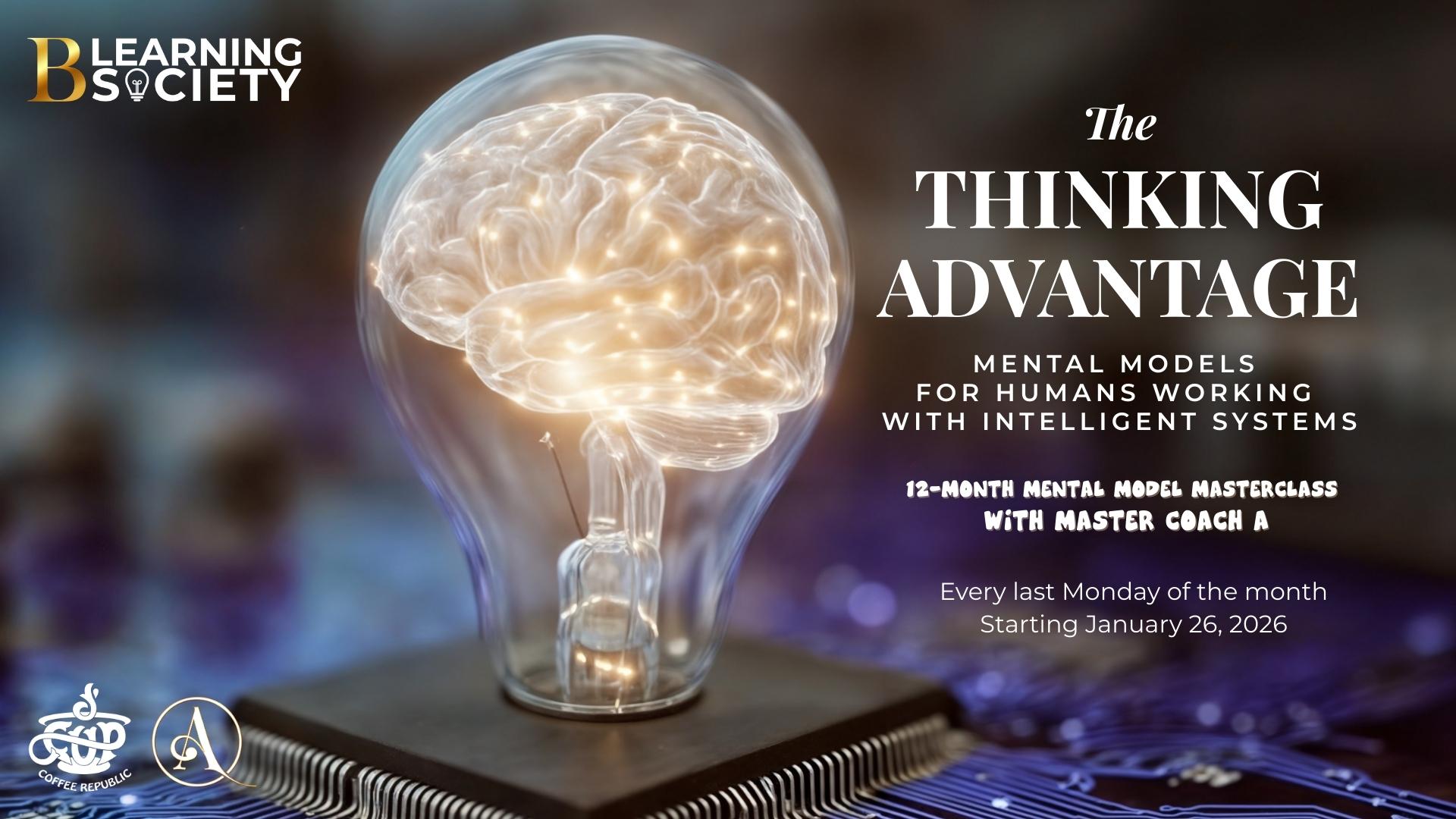
The Thinking Advantage
Mental Models for Humans Working With Intelligent Systems
We stand at an inflection point in human capability. For the first time, we have access to systems that can think, reason, and create alongside us. Yet most people approach AI the way they might approach a search engine or a calculator—as a tool that executes commands rather than a collaborator that thinks.
This fundamentally misses the opportunity.
The question isn’t whether AI will transform how we work. It’s whether you’ll develop the mental models to leverage it effectively while others fumble with surface-level prompts.
This guide isn’t about prompt engineering tricks or the latest features. It’s about upgrading how you think about thinking with machines.
Part I: Reframing the Relationship
From Tool to Thinking Partner
The industrial revolution gave us tools that amplified our physical capabilities. AI amplifies something more fundamental: cognition itself.
But here’s the shift most people miss: effective AI collaboration isn’t about giving better instructions—it’s about creating better thinking environments.
When you work with an AI system, you’re not just extracting answers. You’re constructing a cognitive space where:
- Ideas can be explored without the friction of execution
- Multiple perspectives can be synthesized instantly
- Rough thoughts can be refined through dialogue
- Knowledge gaps can be filled in real-time
The people who thrive won’t be those who write the cleverest prompts. They’ll be those who understand how to create conditions for collaborative intelligence.
The Cognitive Division of Labor
Traditional work meant dividing tasks based on skills and roles. Working with AI requires dividing cognitive labor based on comparative advantage.
Humans excel at:
- Defining what matters (values, priorities, goals)
- Pattern recognition across wildly different domains
- Intuitive leaps and creative connections
- Understanding context, nuance, and unspoken needs
- Asking the right questions
AI excels at:
- Comprehensive analysis of large information sets
- Maintaining consistency across complex requirements
- Generating multiple variations rapidly
- Synthesizing knowledge across disciplines
- Executing structured thinking processes
The magic happens when you stop trying to do everything yourself and start orchestrating this division effectively.
Part II: Core Mental Models
1. The Conversation as Workshop
Old model: Ask a question, get an answer, move on.
New model: Each conversation is a workshop where you’re building something together.
Think of it like working with a skilled colleague who has encyclopedic knowledge but needs you to provide direction, judgment, and iteration.
Practical implications:
- Start conversations with context, not just requests
- Build on previous responses rather than starting fresh each time
- Iterate openly—”that’s close, but let’s adjust X”
- Use the conversation itself as a thinking tool, not just a means to an end
Example: Instead of: “Write a marketing email for my product”
Try: “I’m launching a productivity app for remote teams. The core insight is that async communication isn’t the problem—context switching is. I need to craft messaging that resonates with engineering managers who are drowning in Slack. Let’s start by exploring what pain points would hit hardest, then build an email around the strongest one.”
Vagueness isn’t just inefficient—it’s expensive. Every clarification cycle costs time and momentum.
The counterintuitive insight: spending 2 minutes adding specificity saves 20 minutes of back-and-forth.
High-leverage specificity:
- Constraints: “Keep it under 150 words” / “Use analogies a 12-year-old would understand”
- Format: “Structure this as a decision framework” / “Give me three options with clear tradeoffs”
- Context: “I’m technical but my audience isn’t” / “This is for senior executives who hate jargon”
- Examples: “Like this, not that” / “In the style of X”
The skill isn’t being specific about everything—it’s knowing what to be specific about.
3. The Iteration Mindset
AI enables a fundamentally different creative process: rapid iteration at near-zero marginal cost.
This changes the game entirely.
In traditional work, iteration is expensive. You think hard, execute carefully, and hope you got it right because going back to the drawing board is costly.
With AI, you can:
- Generate 10 variations to find the right tone
- Completely restructure an argument to test different approaches
- Explore dead-ends without wasting hours
- Refine incrementally until it’s exactly right
The best practitioners treat first outputs as raw material, not finished products. They iterate fearlessly.
4. Context Loading
AI doesn’t remember everything you’ve ever told it. But within a conversation, it has perfect memory.
The pattern: Front-load context once, then build on it throughout the session.
This means:
- Starting conversations with relevant background
- Referencing previous exchanges (“building on what we discussed earlier…”)
- Treating each conversation as a cumulative workspace
- Using artifacts and documents to maintain continuity across sessions
Think of it as “warming up” the thinking environment before diving into the hard problems.
5. Collaborative Debugging
When output isn’t quite right, most people start over. Better approach: debug collaboratively.
“This is close, but the tone is too formal—can we make it more conversational?”
“The structure works, but the examples are too abstract. Can we use something from the tech industry?”
“I like the framework, but I need the tradeoffs more explicit.”
This treats the AI as a thinking partner who can adjust course, not a vending machine that dispenses fixed products.
Part III: The 12-Month Learning Path
Understanding AI collaboration is just the beginning. True mastery comes from developing the mental models that make you an effective thinker—with or without intelligent systems.
This is why we’ve designed a year-long journey through the most powerful mental models for decision-making, problem-solving, and creating value in an age of intelligent machines.
Mental Models MasterClass Series with Master Coach A
Every last Monday of the month | Starting January 26, 2026
Month 1 — First Principles Thinking
January 26, 2026
Separating what’s true from what’s assumed
You begin the series by slowing down on purpose. This session helps you strip a problem down to what is fundamental, set aside inherited assumptions, and rebuild your reasoning from a clearer starting point.
Month 2 — Opportunity Cost
February 23, 2026
Seeing the tradeoffs behind every choice
This month brings attention to the hidden costs that travel with every “yes.” You learn to notice what each decision quietly excludes, sharpening your ability to choose intentionally rather than impulsively.
Month 3 — Circle of Competence
March 30, 2026
Knowing where judgment is reliable—and where it isn’t
This session builds grounded confidence by helping you distinguish between areas where your experience supports strong judgment and areas where caution, learning, or collaboration is needed before advising or acting.
Month 4 — Inversion (Thinking Backwards)
April 27, 2026
Avoiding failure before chasing success
Instead of starting with optimization, you begin by asking, “How could this fail?” This shift surfaces risks early and helps you avoid mistakes that are both costly and preventable.
Month 5 — Second-Order Thinking
May 25, 2026
Looking beyond immediate outcomes
This month trains you to follow decisions beyond their first effect. You practice tracing ripple effects—socially, ethically, and over time—so choices are made with clearer long-range awareness.
Month 6 — Compounding
June 29, 2026
How small choices accumulate over time
This session examines why consistency often outperforms intensity. You identify habits, behaviors, and systems that quietly compound—either strengthening or undermining your long-term outcomes.
Month 7 — Jobs To Be Done (JTBD)
July 27, 2026
Understanding what people are really trying to accomplish
Here, you focus on the underlying aims behind behavior. By clarifying what people are truly trying to achieve, you sharpen your ability to offer solutions and guidance that actually help.
Month 8 — Comparative Advantage
August 31, 2026
Focusing effort where human judgment matters most
This month helps you direct your attention toward work where discernment, context, and responsibility create the greatest value—rather than spreading effort thin or competing where it isn’t necessary.
Month 9 — Leverage Points
September 28, 2026
Finding where small changes create meaningful impact
You explore systems and patterns to identify where modest, well-placed actions can lead to disproportionate results. Effort becomes more strategic, not heavier.
Month 10 — Optionality Thinking
October 26, 2026
Keeping future choices open
This session centers on decision-making under uncertainty. You learn to recognize which choices preserve flexibility, which ones create lock-in, and how to keep options open without avoiding commitment.
Month 11 — Antifragility
November 30, 2026
Becoming stronger through challenge
Rather than aiming only to endure disruption, you examine how certain practices, systems, and mindsets improve when exposed to stress and change—and how to apply this in your own work and life.
Month 12 — Agency Preservation
December 28, 2026
Remaining the decision-maker
The series closes by returning to responsibility. You clarify when to rely on tools or systems, when to question them, and when judgment must remain firmly yours.
Each session stands on its own, while also building toward a stronger way of thinking over time. This is not a race to mastery. It is a year-long practice in clearer judgment—meant to support you in making decisions you can stand by, long after the moment has passed.
The thinking advantage isn’t about knowing more. It’s about thinking better—both independently and in collaboration with intelligent systems.
Those who develop these mental models won’t just adapt to the AI era. They’ll shape it.
The question is: will you be among them?
What Your Membership Includes
Learning & Coaching
- Monthly Mental Model Masterclass with Master Coach A
→ Learn one key mental model each month and how to apply it in real decisions. - One-time 90-minute Life Coaching Session with a Senior Life Coach
→ Integrate what you’re learning into your current season of life. - Access to curated learning prompts, reflection guides, and practice challenges between sessions.
Community & Collaboration
- Private Coaching & Learning Community
→ Engage with fellow Mental Model Collectors, share insights, and practice new ways of thinking together. - Priority access to B-Learning events and experiments hosted at D’ Cup Coffee Republic and online.
On-Ground Perks at D’ Cup Coffee Republic
- 5% Food & Beverage discount at D’ Cup Coffee Republic for the duration of your membership
→ Bring your learning sessions, meetups, or quiet thinking time to your Third Place.
Plus: Surprise bonuses and special invitations released only to active members.
Membership Options
₱7,500 – 3-Month Membership
Perfect if you want to experience the rhythm of the Masterclass, coaching, and community.
₱25,000 – One-Year Membership
For those committed to deep mental fitness work and long-term participation in the B-Learning movement.
How to Join
Ready to become a Mental Model Collector and help pioneer the B-Learning Home for Mental Fitness?
📲 Connect with Master E at 0939.919.2235
for membership inquiry, registration assistance, and payment details.